
There is no neutral setting. Every day your site is slow, confusing or invisible, it is quietly handing work to the competitor down the road.
Most business owners think of their website as a brochure. Something you build once, put your phone number on, and forget about. That mental model made sense in 2008. It costs you money now.
Here is what actually happens. Somebody hears your name, searches for you, and lands on your site. Within about three seconds they decide whether you look like a real, competent, currently-operating business — or like something that was thrown together and abandoned. They are not reading your copy yet. They are reading the signals: does it load fast, does it look modern, does it work on the phone in their hand, is it obvious what to do next.
If those signals are wrong, they leave. They do not email you to explain why. You never find out that you lost the job. That is the expensive part — the failure is completely invisible.
The real question
Stop asking “does my website look good?” Start asking “how many enquiries did my website generate last month, and do I know?” If you cannot answer the second question, that is the problem worth fixing first.
What a website is supposed to do for a business
A working website does four jobs. Most sites do one of them badly and none of the rest.
1. It qualifies people before you ever speak to them
A good site answers the boring questions — what you do, where you work, roughly what it costs, whether you handle jobs of their size — so that the people who do call are already halfway sold. That is time back in your week. Instead of ten calls where six were never going to buy, you get four calls where three are ready.
2. It captures enquiries when you are not there
Your phone is off at 9pm. Your site is not. If somebody is ready to enquire at 9pm and there is nowhere obvious to do it, that intent evaporates by morning. Forms, quote requests, callback scheduling, chat — these are not features, they are the difference between an enquiry and a lost one.
3. It proves you are worth the price
Nobody chooses the cheapest option for work that matters to them. They choose the one they trust. Project galleries, before-and-afters, real reviews, clear specifications, an actual named team — this is what lets you charge properly instead of competing on price.
4. It gives you data
Which pages people read. Where they leave. Which service brings the most enquiries. Which ad actually paid for itself. Without this you are guessing, and guessing is expensive at scale.
Why templates stop working the moment you grow
Template builders are genuinely fine for a one-page presence. The trouble starts the moment your business becomes slightly specific — and every real business is specific.
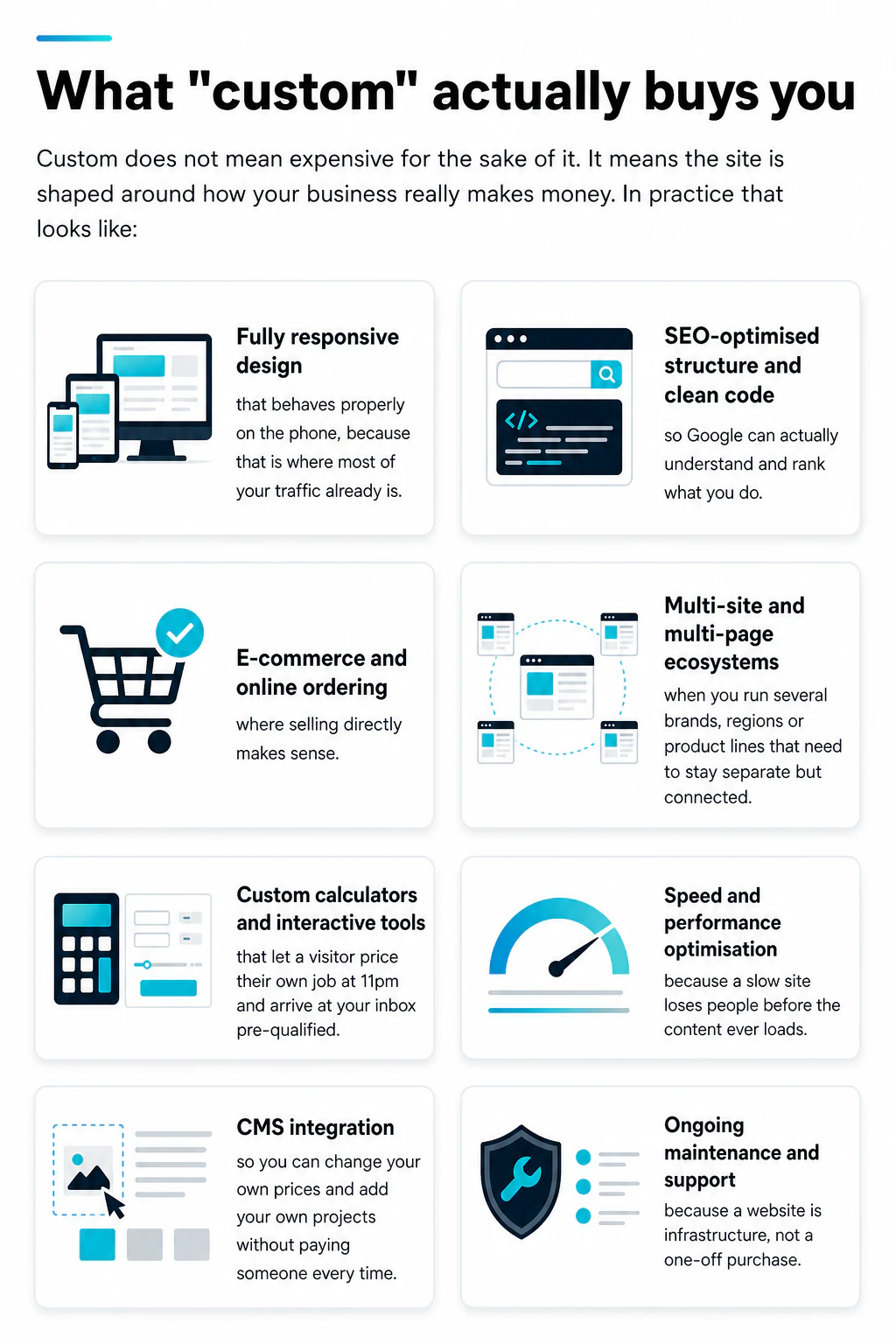
You want to show pricing that depends on square footage. You want customers to see a product on a photo of their own driveway before they buy. You want enquiries from four different sites routed to whoever covers that ZIP code. You want a quote to arrive as a PDF in the customer’s inbox thirty seconds after they built it themselves.
None of that comes out of a template. And the workaround — bolting on six plugins that fight each other — is how sites end up slow, broken after updates, and impossible to change without breaking something else.
Wavefront Studio built our entire website ecosystem from scratch — over 12 connected sites, all running smoothly. Their attention to detail and deep understanding of business was unlike any other agency we’ve worked with.
— Tony Dyke, CEO
The cost of doing nothing
Rebuilding a website feels like a big spend. Not rebuilding it feels like nothing at all — and that is exactly why it wins the argument for years at a time.
Run the arithmetic on your own numbers. If your average job is worth $2,000 and your site is losing you two enquiries a month that a better one would have caught, that is $48,000 a year going somewhere else. The site costs a fraction of that once. The leak costs you every month, forever, and never sends an invoice.
You do not need the fanciest website in your industry. You need one that loads fast, reads clearly on a phone, tells people exactly what to do next, and reports back on whether it worked. Everything past that is a bonus.
Where to start
Open your own site on your phone right now. Time how long it takes to load. Then ask yourself: if I knew nothing about this company, would I call them? Could I even find the number?
That thirty-second test tells you more than any audit report. And if the answer makes you wince slightly, that is worth a conversation — the fix is usually smaller and faster than people expect.
Work out what this is costing you
If your website is quietly losing two enquiries a month, that leak has a dollar figure attached to it. Put your own average job value and enquiry numbers in and see it.
Open the lost lead calculator — it takes under a minute, no signup.
We’re currently waiving setup fees for five businesses this quarter on AI chatbots, web development and SEO. See what’s included, or call +1 (941) 415-2595.